It has to be your animal
A generic dog is easy. Your dog is hard. The difference between the two lives in a handful of millimetres around the eyes and the muzzle, and it is the only thing that matters — because you are the one who will know instantly if it is wrong.
Request a session →-
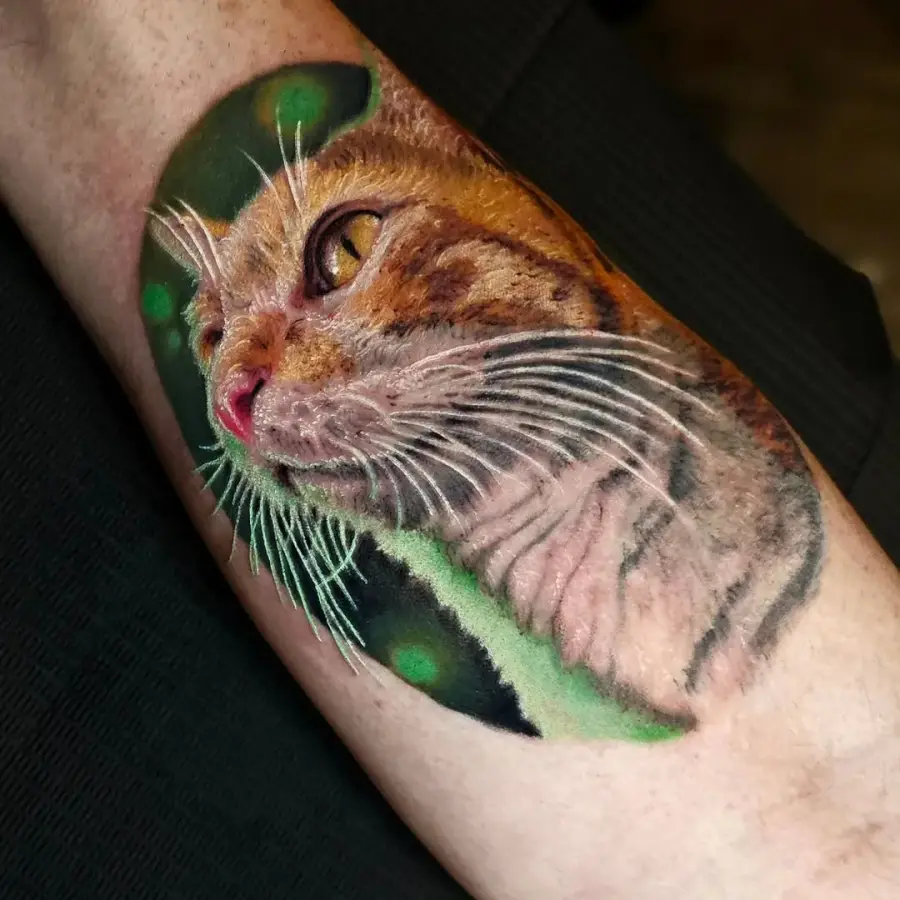
Cat
The whiskers are the tell. They have to break the silhouette and catch light in front of the darker fur, or the whole face reads as a sticker. The green behind exists to stop the orange going flat.
-
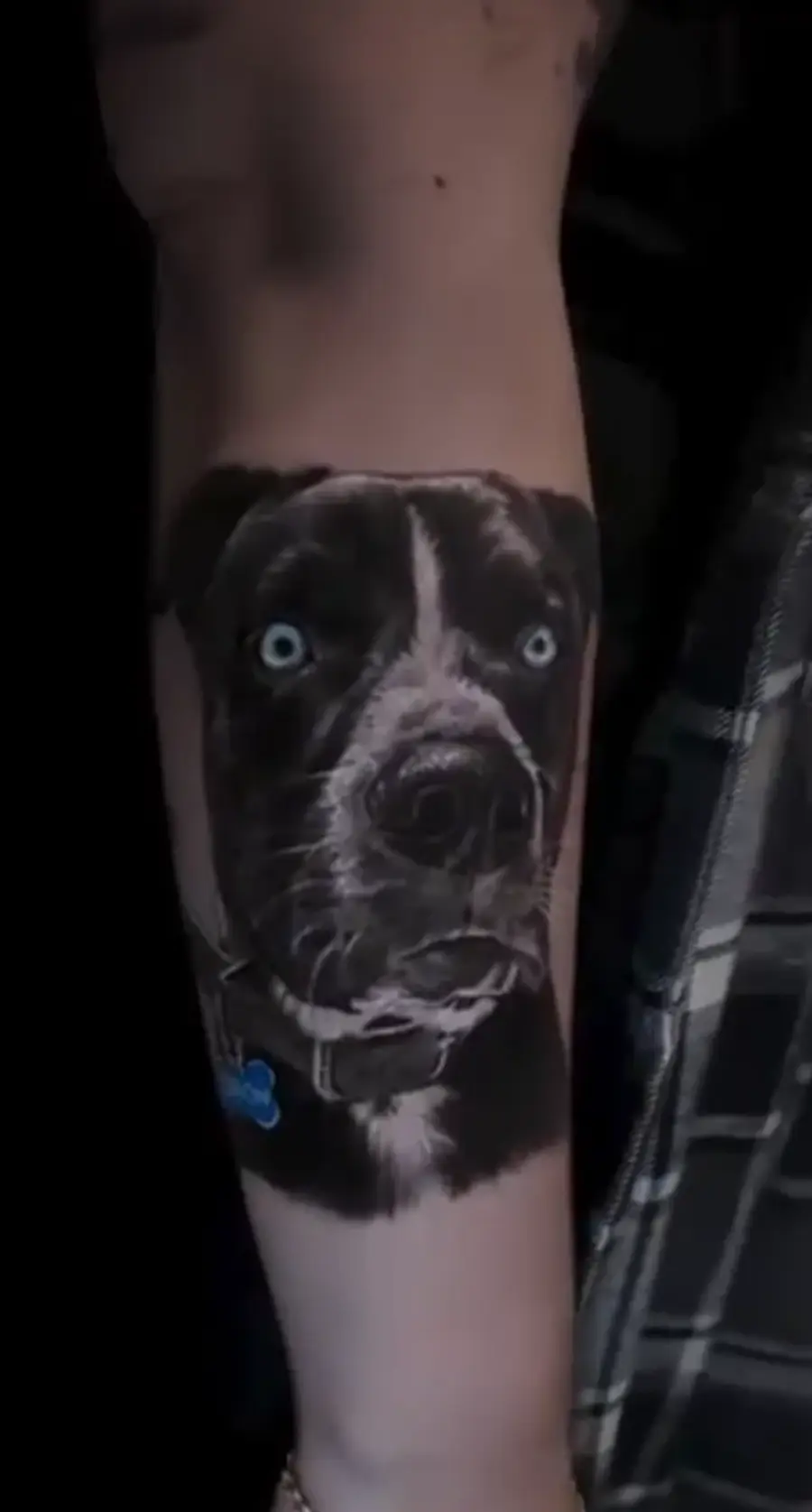
Pitbull
A face that is mostly dark fur, which is the hardest brief in a portrait — almost no internal contrast to work with. The blue of the eyes and the collar tag are the only colour in the piece, and they carry it.
-
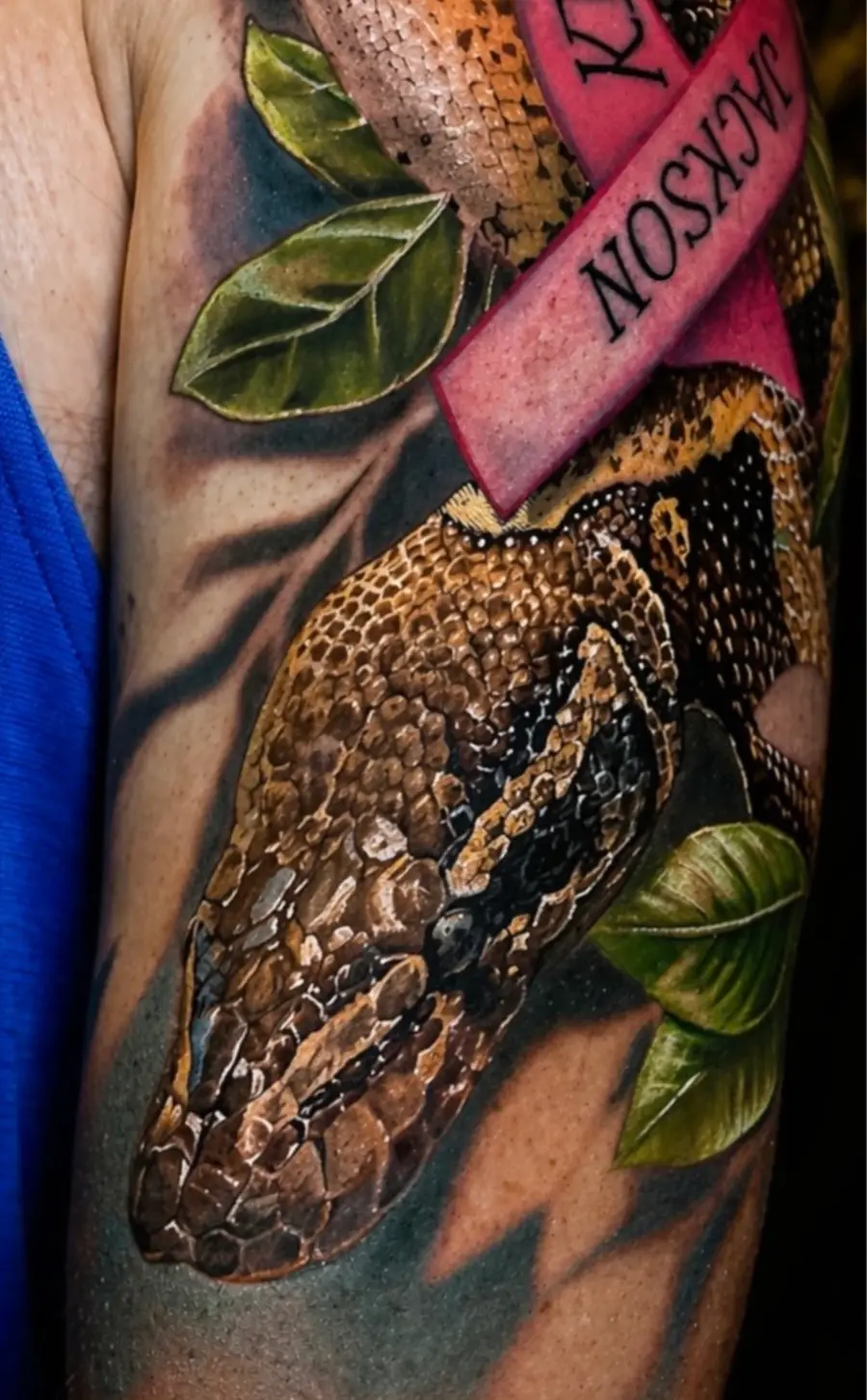
Python · Jackson
Jackson has a name and a banner, because he is somebody's animal, not a stock reptile. Every scale is its own small value study; the leaves are there to make the browns read warm.
-
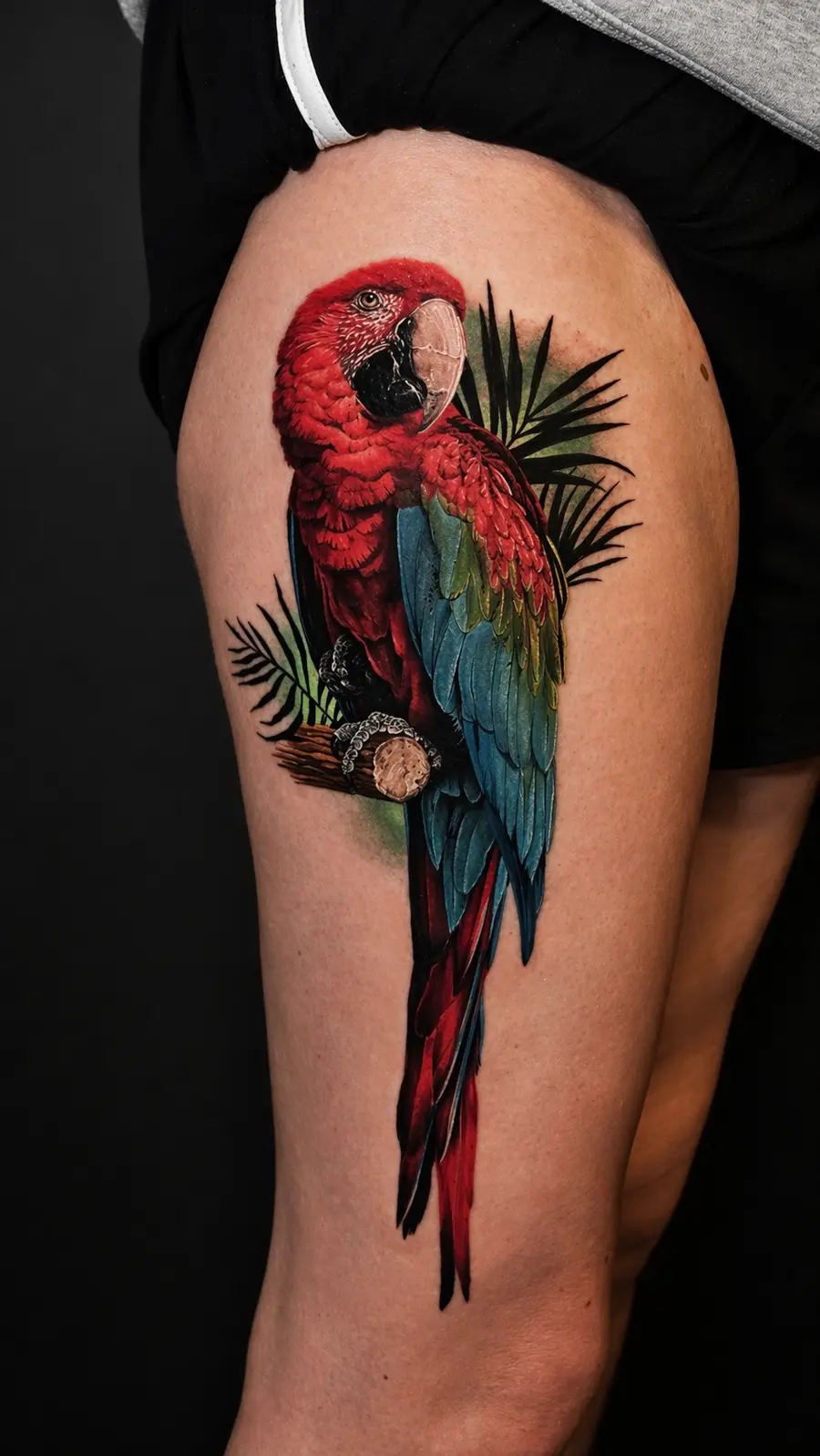
Scarlet Macaw
Feathers are layers, not lines. The red had to stay saturated where it meets the blue without either going muddy at the border — that boundary is where most parrot tattoos fall apart.
-
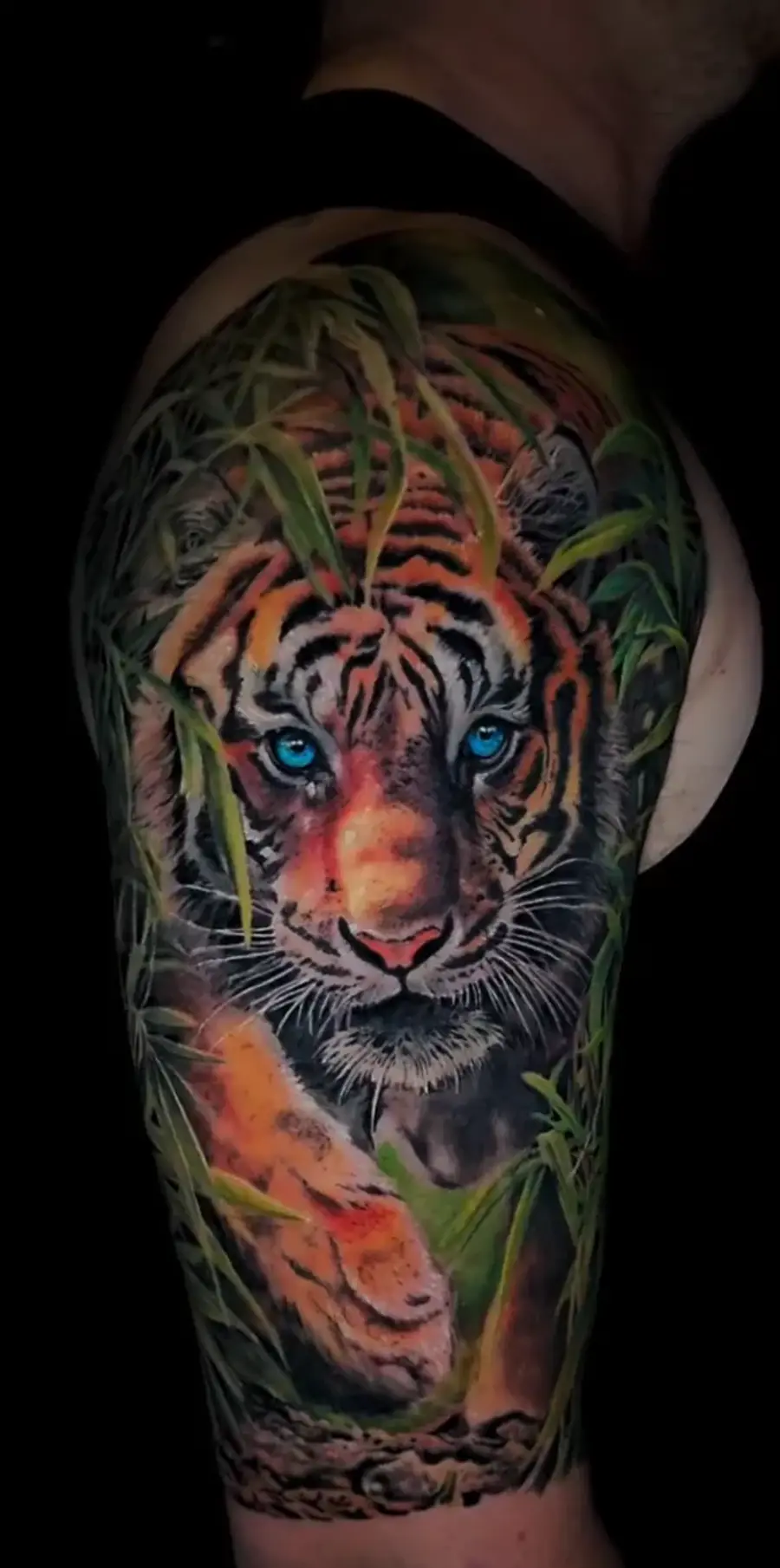
Tiger
The bamboo crossing the face was the whole point. Putting the animal behind something gives the piece a depth a flat portrait cannot have, and it makes the eyes the only fully unobstructed thing.
-
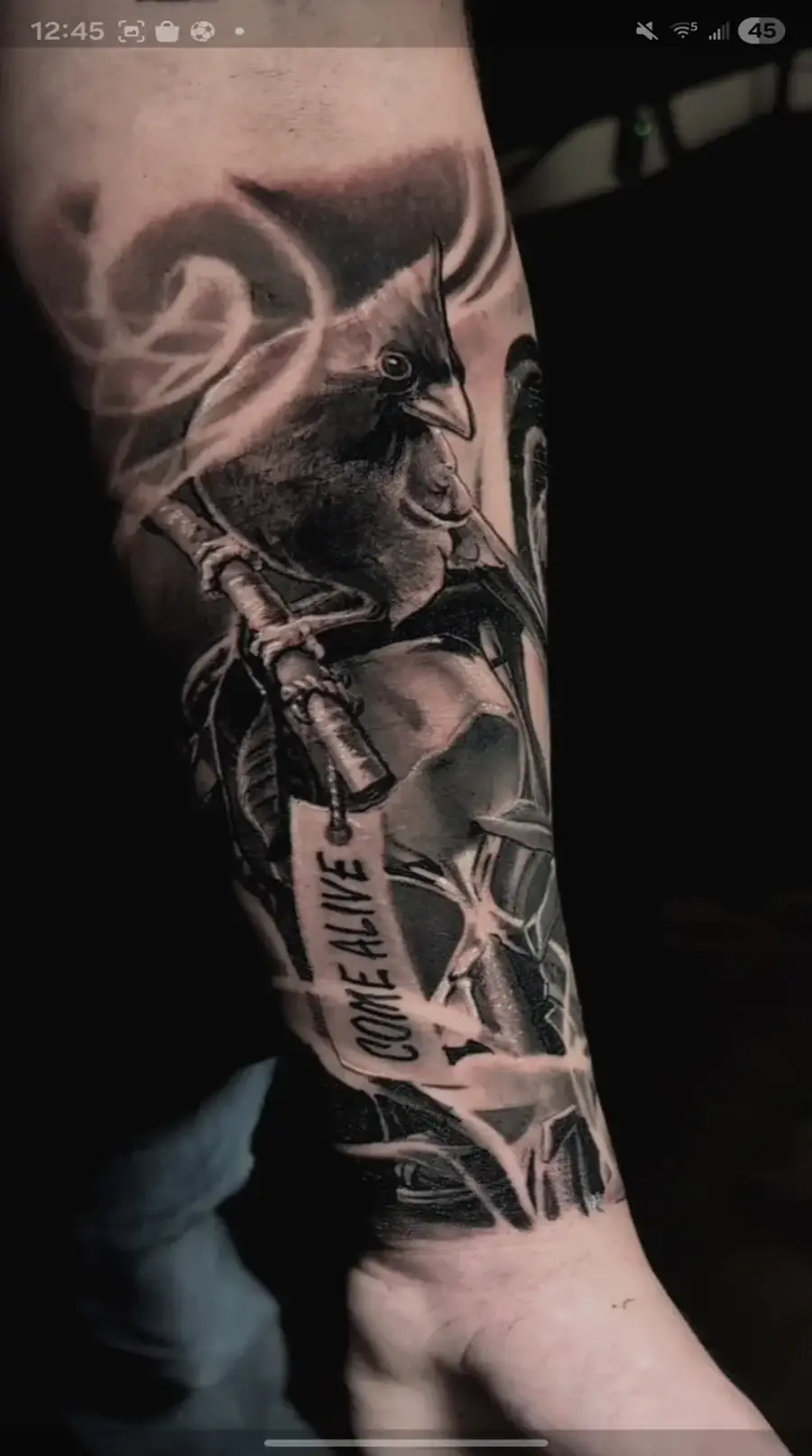
Come Alive
A bird in black and grey has almost no local contrast to work with, so the depth had to come from behind it. The dark field is not background — it is what pushes the cardinal forward.
-
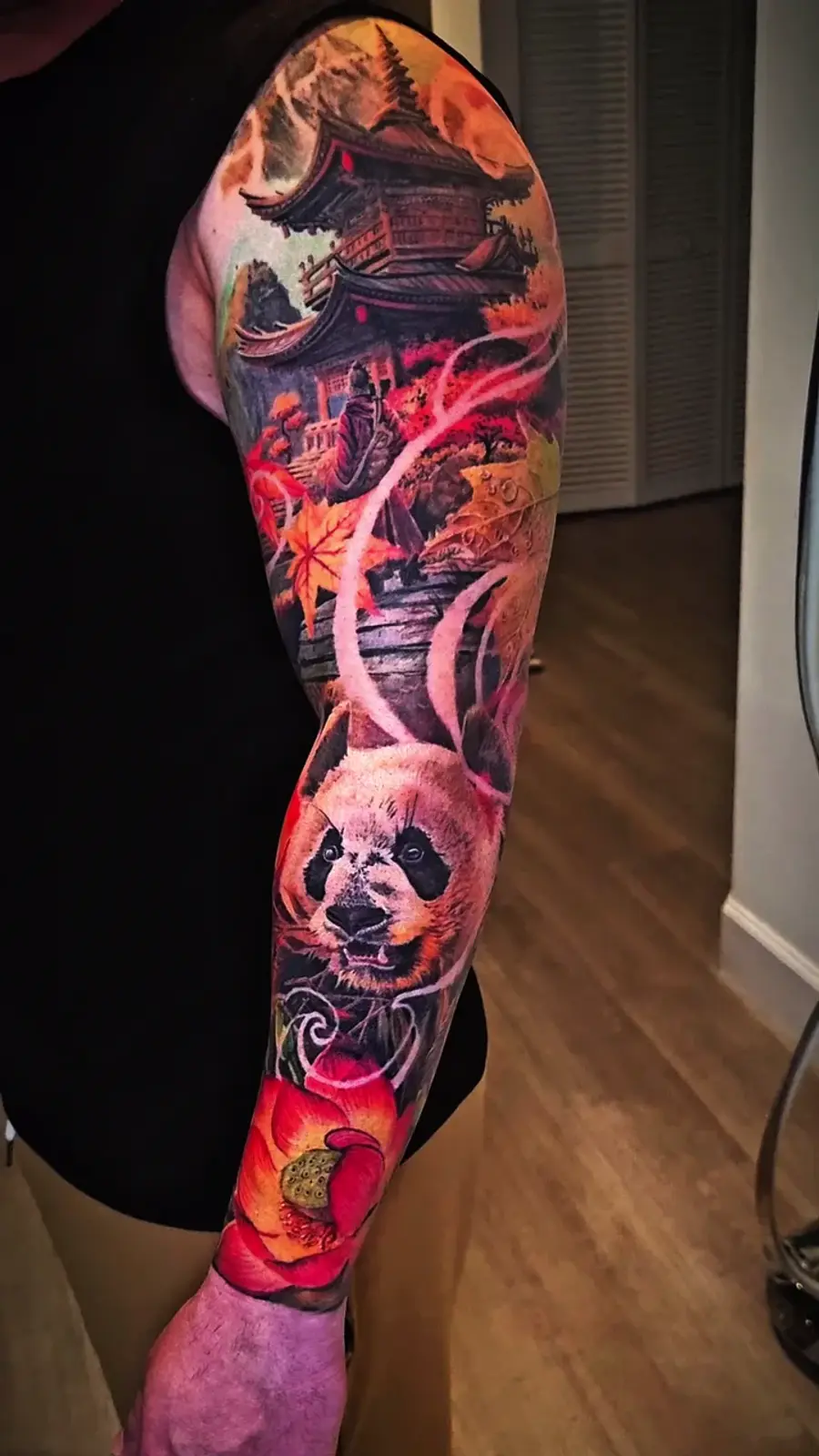
Pagoda & Panda
The panda sits in the middle of a full sleeve and still holds its own as a portrait. Placement is why: it lands at the widest part of the forearm, where a face has room to be read.
Likeness is the whole job
Most tattoo subjects have some tolerance. A rose can be a slightly different rose and nobody is hurt. An animal you have lived with has none — you have looked at that face every day for years, and your eye will catch a two-millimetre error you could never describe in words.
So I work backwards from that. Before anything else I am looking at your photographs asking one question: is the information I need actually in here? Not “is this a nice photo” — is the eye sharp, can I see where the light is coming from, is there detail in the dark fur or has the camera crushed it to black.
That last one is the most common problem, and it is why dark animals are the hardest brief in portrait work. A black dog photographed against a bright window is a silhouette. There is nothing in the file to draw from. The fix is usually a better photo, not a better artist.
What makes a photograph I can use
- Eyes in focus. If nothing else is sharp, this must be.
- Natural light, from the side. Direct flash flattens the face and kills every texture I need.
- At the animal’s level, not from above. A photo taken from human height distorts the muzzle.
- Several angles, even blurry ones. Extra photos tell me the shape of the head, which one photo never does.
- Detail in the shadows. Better a slightly dark photo with information in it than a bright one that has clipped.
If your animal has passed and the photos are whatever exists, bring them anyway. I would rather look and tell you the truth about what they will support than have you assume the answer is no. Sometimes the honest recommendation is a composition built around the animal rather than a straight photographic portrait — and that can be the better tattoo.
There is a fuller version of all this — the exact thresholds that make a photo usable and the ones that quietly ruin it — in my guide to tattoo reference photos.
Colour or black and grey?
For animals this is a real decision, not a preference.
Colour wins when the colour is the identity. A scarlet macaw in black and grey is a bird. A ginger cat loses most of what makes it that cat. If your animal’s markings are what you would describe first, go colour.
Black and grey wins on dark-furred animals, on anything where texture matters more than hue, and when you want the lowest maintenance over decades. It also handles a poor reference better — grey can imply detail that colour would have to commit to and get wrong.
Both hold if you look after them. Colour asks more of you afterwards, especially here; that argument is on the colour realism page and the black & grey page.
Placement matters more than people expect
A face needs width to be readable. The single most common mistake I see in pet portraits is a good drawing put somewhere too narrow — an inner wrist, a small ankle panel — where the features have to be compressed and the likeness dies in the compression.
Forearm, upper arm and thigh give a portrait the room it needs. If you are set on a smaller area, we talk about it at the consultation, because I would rather adjust the concept than shrink a face until it stops being recognisable.
Scale is also why I do not take very small animal portraits. Detail packed too tightly closes up as the tattoo settles, and the first things to go are exactly the fine marks that made it your animal.
Memorial pieces
A good share of this work is for animals that have died. There is no special technique for that. What changes is the conversation.
I will not rush a memorial piece, and I will not promise you something the references cannot deliver. If the photographs will not carry a photographic likeness, I will say so at the consultation and propose something that still carries the animal — a posture, a marking, a detail that was specific to them. That is a decision worth making deliberately rather than discovering on session day.
Booking one
A full session is six to seven hours at $1,500, starting at 11:00 AM, and it is the minimum booking. Most single-animal portraits fit inside one session; a portrait built into a larger composition will not, and we set the count at the free consultation before you owe anything. Current wait is two to four weeks.
The full step-by-step is on the process page, and healing is covered on the aftercare page.
Straight answers
Can you work from a phone photo? Usually yes. Phone cameras are fine. The problem is never the phone, it is the lighting and whether the eyes are in focus.
My dog is solid black. Is that possible? Yes, but the reference has to be good — side light, detail in the fur, not shot against a window. It is the brief where photo quality matters most.
Can you combine two animals in one piece? Yes. That is a composition question and it usually needs more area than two separate portraits would.
Can you add the name? Yes. Lettering integrated into the piece, like the banner in Jackson’s, works better than text placed underneath as an afterthought.